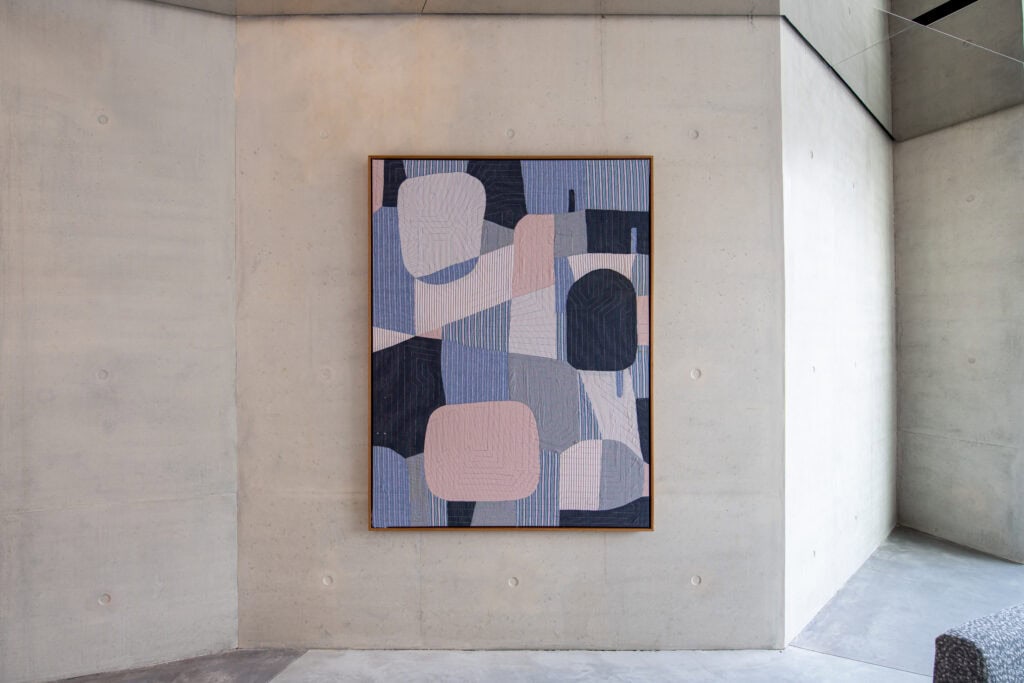

Ismaili Center Houston is pleased to announce Article, a solo exhibition by Gabriel Martinez, opening August 15, 2026. The exhibition takes its name from a monumental hand-sewn textile work that anchors Martinez’s ongoing engagement with material circulation, labor, and shifting conditions of value.
The artworks in the exhibition are constructed from garments found on the street during the artist’s movements across Houston and situate the artist as one body among many involved in the manipulation of the material. They record the traces of global capital, evoking those who dyed and printed the fabric, those who assembled the garments, the people who wore and lost them, as well as the artist who places them back into circulation as luxury objects. The pieces are an invitation for the viewer to consider not only their formal composition and the laborious nature of their production, but also the disjunctive economies that enable such shifts in value.
The centerpiece of the exhibition is a thirty-foot wall-sized composition, sewn entirely by hand without assistants, collaborators, or a sewing machine. The artwork highlights the labor involved in the garment industry and the environmental toll of an unsustainable industry drawing a correlation between the creation of the quilt and the labor histories embedded in the garments themselves.
Presented within the Ismaili Center’s architectural and cultural context, the exhibition reflects an ongoing interest in how contemporary artistic practices engage place, material knowledge, and lived experience. The found pieces of fabric used in Martinez’s quilts are repurposed and adapted to new meanings of care for the environment and the body. Martinez’s work, held within the Center’s permanent art collection, extends its commitment to fostering dialogue with Houston’s artistic community through sustained exchange and public engagement.
Art inspired by the craft tradition, such as Martinez’s hand-sewn quilts, holds particular significance within the framework advanced by the Aga Khan Trust for Culture, which emphasizes the preservation of traditional knowledge systems and understands cultural production as a vital means of strengthening social life and shaping shared environments. Within this framework, Martinez’s practice resonates with broader questions of how materials carry memory, how craft-based knowledge persists within contemporary systems of circulation, and how value is continuously produced and transformed.
In this way, Article offers a sustained attention to the materials that move across the globe and define everyday life.
Please join us for an opening reception on August 15, 2026 from 5:00pm – 8:00pm.